
Table of Contents
Where an E15 nursery loader fits in a nursery material flow
A nursery does not buy a small loader simply to move a pile. It buys a way to keep growing media moving from storage to the next process without blocking deliveries, damaging bags or interrupting staff. The E15 nursery loader merits an assessment where the receiving point is low, the passages are narrow and individual transfers are modest. Its published 0.2 m³ bucket and 700 kg rated load give a starting point for that assessment; they do not establish the output of a mixing line or the machine's suitability for every substrate. Here, nursery loader describes a proposed application of the E15 lithium battery loader, not a separately verified model or a tested customer installation.
Assign one person to describe the receiving process and another to measure access. Those two descriptions often reveal a mismatch early: the loader may reach a bin but leave no room for an operator to inspect the filling point. Bring the E15 nursery loader enquiry back to that practical interface. A purchasing decision should describe where material leaves the bucket and what happens immediately afterwards.

E15 nursery loader bucket volume and payload limits
The E15 nursery loader specification lists 700 kg rated load and a 0.2 m³ bucket. Volume determines how much space a material occupies; mass determines how much it weighs. Substrate can change with moisture, compaction and ingredient mix, so use representative measured bulk-density information from the material supplier or your own documented process. An apparently full bucket of one ingredient need not weigh the same as an equally full bucket of another.
Ask how the quoted bucket is measured, which material characteristics it is intended to handle and which payload conditions apply. Discuss sticky or wet material that may remain in the bucket after discharge. If the E15 is expected to feed a recipe-controlled process, specify how ingredients will actually be weighed. A bucket is a handling attachment; its nominal volume does not make it a dosing instrument.
Measure the bin lip and the discharge space
The published dumping height is 2,000 mm. Treat that as a parameter to discuss with the supplier, not proof that every bin below two metres can be filled. The bucket must approach, rotate and release material without striking the lip or an overhead structure. The receiving opening also needs enough depth and width for the proposed discharge. Ask for the dimension reference and relevant bucket-position drawing for the E15 nursery loader configuration being quoted.
For an E15 demonstration, use the intended receiving point where possible. Observe discharge distribution and material left behind, while the activity is planned and supervised appropriately. If the loader can only reach the near edge, the nursery may need a redesigned receiver. Agree that change before ordering, rather than assuming staff will redistribute every load by hand.
Survey the route during normal nursery activity
Listed overall dimensions are 3,520 × 1,080 × 2,120 mm, with 1,650 kg operating weight and 23×8.5-12 tyres. Confirm the dimension basis and fitted bucket envelope on the quotation. A 1,080 mm width is useful for screening a passage, but it is not a recommended gate width. The E15 nursery loader still needs appropriate clearance, room to steer and separation from people working along the route.
Check the return journey as carefully as the loaded leg. Staff may place stock behind a machine once it has passed, or a delivery may occupy the turning area. The E15 route should remain usable through the operating day. A marked and managed route can be part of the proposed workflow, but its design needs the site's own assessment and operating arrangements.
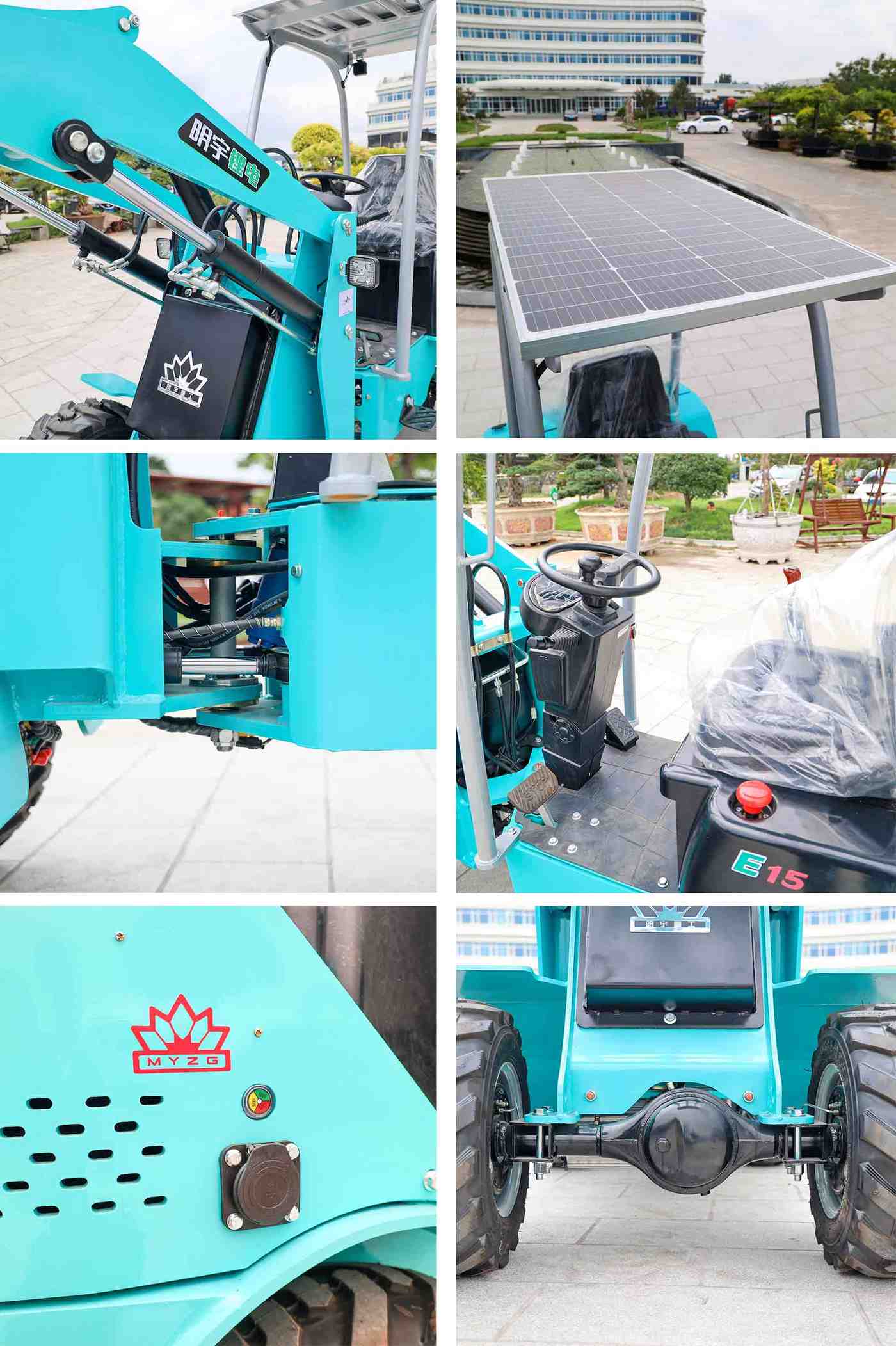
Compare three transfer arrangements before choosing equipment
An E15 nursery loader may be considered when storage positions change and several low receivers need service. A fixed transfer arrangement may deserve attention where the material path remains unchanged. Preblended deliveries shift some mixing work upstream but also change storage and supply requirements. Identify which flexibility the nursery actually needs before assigning value to it.
Avoid comparing only the purchase line. Include receiver alterations, charging provision, weighing method, spill recovery and the staff time required by the proposed process. Keep estimates labelled as estimates. An E15 nursery loader quotation becomes more useful when the supplier understands which part of the flow must improve and which constraints cannot change.
| Arrangement | Potential fit to investigate | Evidence to collect |
|---|---|---|
| E15 nursery loader to low bin | Several storage points and changing transfer routes | Discharge drawing, access survey, observed transfer sequence |
| Fixed conveyor arrangement | Repeated transfer along one defined path | Material compatibility, receiver interface, installation layout |
| Preblended substrate supply | Ingredients can be combined before delivery | Recipe agreement, storage plan, delivery quantities |
| Existing manual method | Small or irregular quantities | Measured handling demand and site assessment |
An E15 nursery loader charging plan around actual breaks
The product page specifies a lithium battery rated 76.8 V/210 Ah. Voltage multiplied by ampere-hours gives a nominal arithmetic value of 16.128 kWh. That is not the usable energy available to the operator, and dividing it by an assumed power draw would not prove working time. Request the battery and charger details relevant to the supplied E15 nursery loader and explain the planned pattern of work.
The E15 nursery loader charging location also affects the material flow. It should not turn the main substrate approach into a parking space or require cables across a busy route. Have the appropriate site personnel assess the electrical installation and follow the supplied instructions. Obtain a realistic trial or supplier assessment for the stated duty cycle before treating the charging plan as resolved.
Use a trial to investigate the process bottleneck
Set a trial question that can be answered by observation: can the proposed process transfer a defined material to the intended receiver without causing queues or requiring unplanned manual redistribution? Document the material, its condition, the receiving arrangement and the E15 nursery loader configuration. A trial on a different dry material in an open yard may be informative, but it cannot establish the nursery's complete operating result.
Ask operators and receiving staff to review visibility, access to controls and communication during the trial. Decide how spills and ingredient changes will be handled. Keep any E15 nursery loader trial findings tied to the tested material and layout, and list unresolved items explicitly. That record is more useful to purchasing than an unsupported statement that the machine can keep up with every production day.
Specify the nursery package in the purchase enquiry
Send a concise application file containing the material list, measured density information where available, receiving-bin sketch, route measurements, daily work pattern and charging windows. Ask MINGYU to identify the E15 nursery loader, bucket, battery and charger included in the offer. Request the relevant manuals, dimension drawings and information needed to assess use at your destination. Avoid allowing an attractive photograph to define the attachment scope.
A well-defined E15 nursery loader enquiry allows the supplier to answer a nursery problem rather than merely price a model. If the receiver is too high or the route cannot be made suitable, resolve that first. Once those constraints are addressed, a configuration-specific quotation can be compared against the intended transfer arrangement with far fewer assumptions.
Explore the E15 electric wheel loader specifications, the lithium battery loader range and MINGYU service and support. For wider workplace planning, refer to the relevant official guidance alongside the machine instructions and applicable local requirements.
Send MINGYU your nursery receiver sketch, material list and daily transfer schedule. Request an E15 nursery loader package with the bucket and charger identified, the relevant discharge dimensions and an assessment of the proposed work and charging pattern.
Frequently asked questions
Can an E15 nursery loader feed a nursery substrate mixer?
It is an application to assess, not a verified installation claim. Compare the receiver geometry with the published 2,000 mm dumping height and request the bucket-position drawing for the proposed configuration.
Does a 0.2 m³ bucket provide a repeatable batch weight?
No. Mass depends on material density and actual fill. Use an appropriate weighing method if the nursery process requires controlled ingredient quantities.
Will the E15 nursery loader fit a 1,080 mm opening?
The listed machine width is 1,080 mm, but an opening of the same width provides no clearance. Confirm the complete envelope and have the route assessed with adequate room for movement and site controls.
How long will the battery operate between charges?
The captured specification gives 76.8 V/210 Ah and does not establish runtime for this task. Submit the nursery duty pattern and charging windows for a configuration-specific assessment.
What should accompany an E15 nursery loader quotation request?
Include the materials, bin dimensions, access survey, shift pattern, charging supply information and destination. Identify any weighing or receiver modifications that are part of the proposed process.