
Table of Contents
Start E10 charging planning with the loading task
An E10 charging plan should begin at the material pile and end at the receiving point. The important question is whether the machine can complete the required loading work within the available working and charging periods. A battery number alone cannot answer that question. The route, material, bucket fill, receiving height and interruptions all affect the working day. Record those conditions before asking for a runtime estimate or choosing a charger.
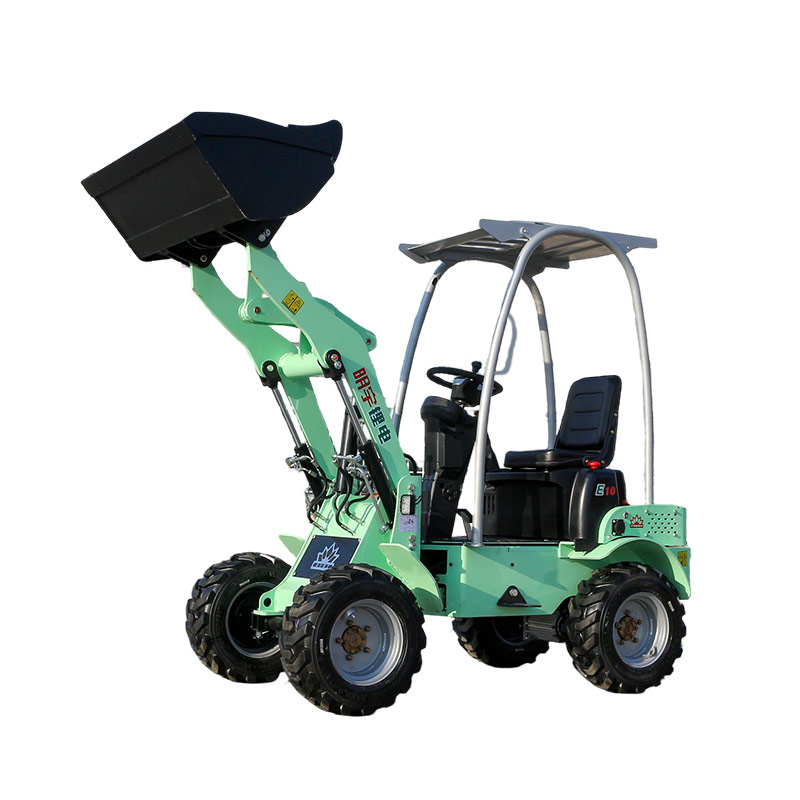
The E10 product page lists a 500 kg rated load, a 0.16 m³ bucket, a 1,400 mm dumping height and a lithium battery rated at 76.8 V and 205 Ah. These are useful starting points for a compact loading application. They do not establish usable battery energy, continuous runtime or charging time. This guide separates published specifications from hypothetical calculations, then shows what evidence to request before making an equipment and charging decision.
Read the battery specification without turning it into a runtime promise
Multiplying the listed voltage by ampere-hours gives a nameplate energy calculation: 76.8 × 205 ÷ 1,000 = 15.744 kWh. The arithmetic describes the nominal size represented by those two published values. It does not tell the owner how much energy the battery management system permits the machine to use, what reserve is required, or how energy availability changes with condition and temperature. Ask the supplier to confirm those points for the battery actually included in the quotation.
A common estimating mistake is to divide nameplate energy by the motor rating and call the result runtime. Motor rating and average power demand are different measures. A loader alternates between filling, travelling, lifting, steering, discharging and waiting. Some functions can overlap, while other periods involve little useful work. The E10 charging enquiry therefore needs a representative duty cycle and the applicable battery operating instructions, rather than a calculation based on a single maximum component figure.
Check the bucket and receiving height before designing charging breaks
Before planning E10 charging, check the task geometry. The E10 bucket volume is 0.16 m³. For an illustrative fill factor of 0.8, the collected volume would be 0.128 m³. If a measured material density were 1,400 kg/m³, the corresponding material mass would be 179.2 kg. This is a planning example, not a verified E10 bucket fill or an approved payload. Wet material, large pieces and a different bucket shape can change the result. Confirm the permitted load for the supplied configuration and use actual material information.
The listed 1,400 mm dumping height can be a decisive application constraint. Show the receiving bin or trailer in section, including its side height, the approach and the clearance required throughout discharge. A machine that cannot reach the receiving position will not become suitable through a larger battery or more charging time. Check the loading geometry first. When the bucket and receiver match, the energy trial can measure the actual task instead of an easy demonstration that omits the difficult discharge.
Map E10 charging around work and waiting
For E10 charging, prepare a daily timeline with separate entries for machine inspection, productive loading, travel between work areas, waiting, breaks and planned charging. Mark when the loader and charger can physically meet. A lunch break is not a charging opportunity if the machine is working at a distant location or another vehicle blocks the charging position. Include the time required to finish the current task, return to the charging area and resume work afterwards.
For example, a site might plan three loading windows separated by deliveries and operator breaks. The relevant question is how much energy each loading window consumes and whether the permitted charging arrangement can replenish enough between them. Do not assume that every idle period should be used for charging. Ask MINGYU to confirm the approved charging practice for the supplied battery and charger, including any temperature, state-of-charge or other restrictions that affect the proposed calendar.
Confirm the E10 charging equipment and site supply
The E10 charging enquiry should identify the supplied charger. The E10 page identifies the battery voltage and capacity, but those numbers do not specify the building electrical supply. Request the charger model and its input voltage, phase, frequency, current requirements and connector details. Ask which protective devices, earthing arrangement and environmental conditions the installation requires. Have a qualified electrician review the actual site supply and the manufacturer information. Record the installation responsibilities in the quotation so the machine and charger do not arrive before the site is ready.
Keep charger input energy separate from energy delivered to the battery. In a hypothetical measurement, drawing 2.6 kWh from the site to restore 2.0 kWh to the battery would leave 0.6 kWh outside the stored-energy increase. That example is not an E10 charger efficiency claim. It illustrates why a cost estimate should use a measured wall-energy figure, while the shift assessment should use the relevant battery and machine evidence. Confirm what each meter or software display actually measures.
| Information | What it describes | What still needs confirmation |
|---|---|---|
| 76.8 V and 205 Ah | Published battery nameplate values | Supplied battery and operating limits |
| 15.744 kWh | Nominal arithmetic from nameplate values | Usable energy and reserve |
| Charger electrical input | Site supply and installation requirements | Exact supplied charger documentation |
| Representative measured use | Energy for a documented task | Variation with route, material and conditions |
| Local electricity tariff | Cost of metered site energy | Applicable charges and tariff structure |
Use a repeatable trial for E10 charging estimates
For E10 charging measurements, choose a normal material and route, then document the battery starting condition, attachment, operator and weather or indoor conditions. Record completed loading cycles, useful material moved, productive time and interruptions. Capture the battery readings through an approved method at the beginning and end. A trial should be organised by competent personnel under the site operating arrangements. It should not require exceeding a rating or continuing to use a machine that displays a warning or abnormal behaviour.
Calculate average consumption only over the time basis that was measured. If a hypothetical trial used 4 kWh during two hours of representative work, average demand over that measured period would be 2 kW. If the supplier separately confirmed 12 kWh of usable energy for the relevant operating condition, dividing 12 by 2 would give a six-hour arithmetic estimate for that same duty pattern. Neither 4 kWh nor 12 kWh is a verified E10 result here. Replace both with appropriate evidence before using the estimate.
Separate output per cycle from output per clock hour
E10 charging planning and production planning should refer to the same task. Using the earlier hypothetical collected volume of 0.128 m³ and a measured rate of 20 completed cycles per productive hour would give 2.56 m³ per productive hour. The assumed cycle rate is not an E10 performance specification. If the site then loses an hour to waiting for a receiving vehicle, total daily output changes even if consumption per productive cycle does not. Report both the cycle evidence and the time available to use it.
Look for waiting and layout problems before changing the charging equipment. A receiving bin that is frequently unavailable, a long reversing movement or material stored in the wrong place can reduce useful output. A clearer route may improve the number of completed cycles during the same shift. Conversely, a faster route can increase sustained energy demand because the machine spends less time waiting. Repeat the energy assessment when the work pattern changes materially instead of carrying the old runtime assumption into a new operation.
Check E10 charging access against the route dimensions
An E10 charging position must be reachable. The published E10 dimensions are 3,010 × 1,080 × 2,120 mm, and the listed operating weight is 1,150 kg. Ask which attachment and travelling condition those dimensions represent. Survey the route to the charging position, including gates, overhead obstructions, ramps, drainage and other vehicles. A straight-line width comparison is only an initial dimensional check. For example, a 1,200 mm opening would exceed the listed width by 120 mm in total, but that subtraction does not establish adequate operating clearance.
Arrange the charging position so the operator can follow the supplied connection and inspection procedure without cables crossing an active vehicle route. Confirm the charger environment requirements and site traffic controls. The catalogue operating-weight figure also needs the correct interpretation when planning ground support or transport. Do not automatically add 500 kg to 1,150 kg and treat the result as an approved transport or ground-loading specification. Request the relevant mass definition and actual supplied configuration for each assessment.
Budget for E10 charging with measured site energy
For the E10 charging budget, build the energy estimate from the amount measured at the site supply and the tariff that applies there. If an illustrative operation consumed 18 kWh from the wall in a day and paid 0.20 currency units per kWh, energy cost for that day would be 3.60 currency units. Those inputs are hypothetical. Include any relevant tariff structure or charging installation cost separately, and avoid importing a general electricity price into a quotation for a different country or customer.
Compare energy cost with the useful work completed. Dividing by clock hours can make a lightly used machine look inexpensive while hiding low output. Keep productive loading hours, completed cycles and material quantity alongside consumption. Other ownership costs include the supplied charger, installation, transport, planned maintenance and support arrangements. Battery warranty and replacement conditions should come from the confirmed agreement. The product page does not establish a guaranteed battery life, payback period or percentage saving for the proposed site.
Prepare an E10 charging enquiry and handover record
Support the E10 charging enquiry with a clear task description. Send MINGYU a description of the material, measured density where relevant, receiving height, route dimensions, daily loading windows and available electrical supply. Identify the E10 model and the requested attachment. Ask for the supplied battery and charger identities, the approved charging instructions, a configuration-specific duty-cycle discussion, packing information and the applicable support and warranty terms. Include destination country or port and quantity so the technical recommendation and commercial quotation describe the same equipment.
At handover, confirm the delivered configuration against the order, inspect its condition and retain the manual and charging information with the machine record. Agree who performs the checks and who receives fault reports. Establish a representative baseline trial during commissioning, then review actual use after the first operating period. This gives the owner a practical E10 charging and shift plan that can be revised when the route, material or working calendar changes. It also gives the supplier clear evidence when additional technical support is needed.
Explore the E10 electric wheel loader specifications, the lithium battery loader range and MINGYU service and support. For wider workplace planning, refer to the relevant official guidance alongside the machine instructions and applicable local requirements.
Discuss E10 charging with MINGYU using your material, receiving height, loading windows and electrical-supply details. Request the exact battery, charger and operating information for the configuration offered.
Frequently asked questions
What is the E10 battery capacity?
The published specification lists a lithium battery at 76.8 V and 205 Ah. Multiplying those figures gives 15.744 kWh of nominal nameplate energy. Usable energy and operating limits require confirmation for the supplied battery.
How should E10 charging be planned for a working shift?
The captured product table does not establish a duty-cycle-specific runtime. Request the relevant battery information and measure a representative loading task. Material, travel, lifting frequency, waiting and operating conditions affect the result.
Which electrical supply does E10 charging require?
No. Battery voltage and ampere-hours do not specify the charger input or site installation. Confirm the supplied charger model and have a qualified electrician assess its installation requirements.
Can opportunity charging be included in the shift?
Include it only when the battery and charger instructions permit the proposed practice and the site provides a suitable charging opportunity. Confirm the operating restrictions and actual time available before relying on breaks in the production plan.
What can prevent the E10 from fitting the application?
The loading envelope or route can be decisive. Check the listed 500 kg rated load, 0.16 m³ bucket and 1,400 mm dumping height against the actual material and receiving position. Confirm the supplied configuration and site conditions before ordering.